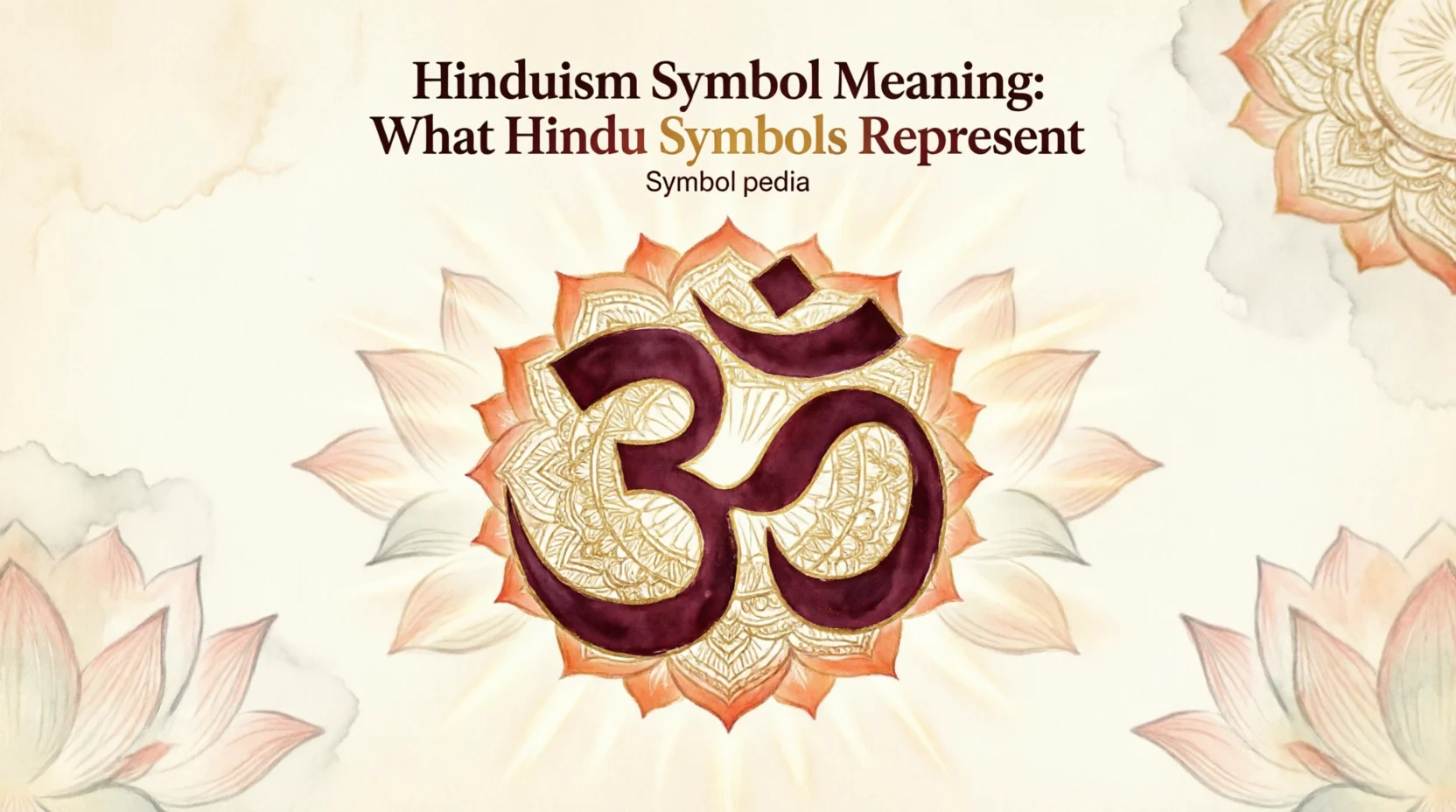
When people search for Hinduism symbol meaning, they are often looking for one simple answer: What does the Hindu symbol actually mean?
The difficulty is that Hinduism does not have only one symbol. It is a rich religious tradition with thousands of years of philosophy, rituals, stories, sacred sounds, deities, and visual traditions. Several symbols are closely associated with Hinduism, and each carries its own meaning.
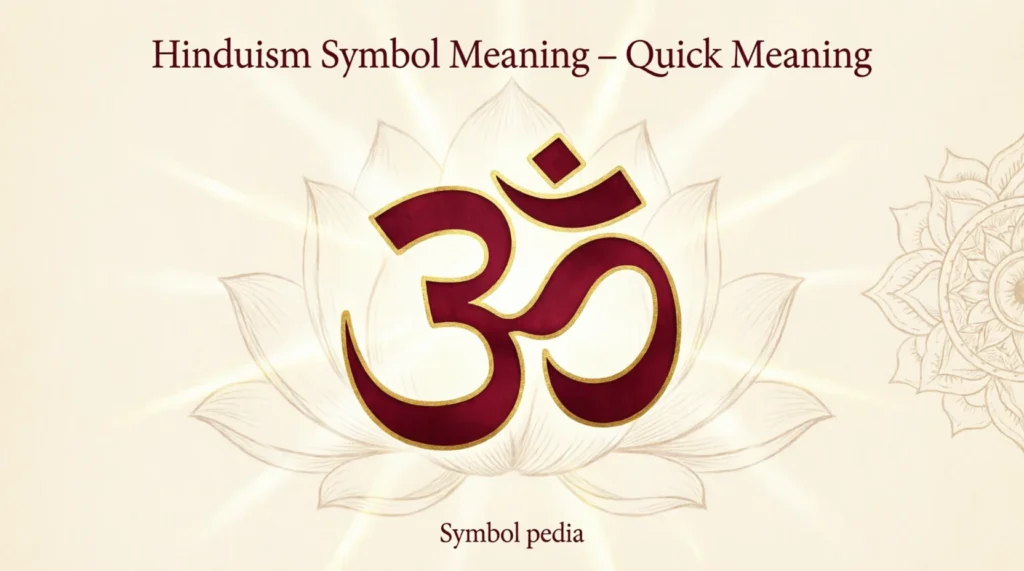
The most widely recognized is Om (ॐ), a sacred syllable and visual symbol associated with ultimate reality, consciousness, and the sacred sound of existence. Other important symbols include the lotus, swastika, trishula (trident), tilaka, and sacred representations connected with Shiva, Vishnu, Lakshmi, and other Hindu traditions.
Understanding these symbols requires more than translating them into one English word. A symbol may represent a philosophical idea, a spiritual practice, a deity, protection, prosperity, purity, or a particular religious tradition.
This is especially important today because Hindu symbols appear everywhere—from temples and prayer rooms to jewelry, tattoos, clothing, artwork, yoga spaces, and social media profiles.
So, what do these symbols really mean, and how should they be understood respectfully?
Hinduism Symbol Meaning – Quick Meaning
The phrase Hinduism symbol meaning generally refers to the spiritual, religious, cultural, and philosophical significance of symbols associated with Hindu traditions.
Here are some of the best-known examples:
- Om (ॐ): Represents a sacred sound and profound spiritual reality.
- Swastika: Traditionally represents auspiciousness, well-being, prosperity, and good fortune in Hindu contexts.
- Lotus: Represents purity, spiritual growth, beauty, and the ability to rise above difficult circumstances.
- Trishula: Shiva’s trident, associated with Lord Shiva and various theological interpretations of threefold realities.
- Tilaka: A mark worn on the forehead that can express religious identity, devotion, or participation in a particular tradition.
- Lotus feet: Symbolically associated with reverence, devotion, and spiritual surrender.
For example, someone might say:
“I wear an Om pendant because it reminds me to stay grounded.”
Or:
“The lotus represents growing through difficult experiences.”
Another person might explain:
“The swastika in my family’s Hindu tradition represents auspiciousness and well-being.”
The important point is that there is no single Hindu symbol with one universal interpretation for every Hindu person.
Origin & Background
Hindu symbols developed over centuries through religious texts, ritual practices, temple traditions, philosophical schools, mythology, and everyday customs.
Unlike a modern brand logo, these symbols often have layers of meaning. A single image can connect religious practice with philosophical ideas about life, consciousness, duty, nature, or the divine.
Om: The Sacred Sound
Om, written as ॐ or Aum, is probably the symbol most people associate with Hinduism.
It is traditionally connected with sacred sound and is discussed extensively in Hindu philosophical and scriptural traditions. The sound is commonly used in meditation, prayer, chanting, and other spiritual practices.
Its written form has also become a recognizable visual representation of Hindu spirituality.
However, Om is not simply a decorative symbol meaning “peace.” Its significance is much deeper and varies somewhat across Hindu philosophical traditions.
The Swastika
The swastika is another ancient symbol with an important place in Hindu culture.
In Hindu contexts, it traditionally carries positive associations such as auspiciousness, prosperity, well-being, and good fortune. It can appear during festivals, weddings, religious ceremonies, household rituals, and on objects associated with blessings.
Its meaning is frequently misunderstood because the Nazi regime appropriated a similar symbol in the 20th century and gave it an entirely different political meaning.
For that reason, context matters enormously.
The Lotus
The lotus has a particularly powerful place in Hindu symbolism.
A lotus grows from muddy water while producing a beautiful flower above the surface. This natural image has become a meaningful metaphor for spiritual development.
It can suggest purity, beauty, detachment, renewal, and the journey from difficult circumstances toward spiritual awareness.
The lotus is also strongly associated with several Hindu deities, including Lakshmi and Saraswati.
Shiva’s Trishula
The trishula, or trident, is closely associated with Shiva.
Its three prongs have been interpreted in several ways within Hindu thought, including associations with different triads and dimensions of existence. It is not simply a weapon in the ordinary sense; in religious imagery, it can represent divine power and theological concepts connected with Shiva.
This is a good example of why Hindu symbols should not always be reduced to one-word definitions.
Real-Life Conversations
Symbols often become part of ordinary conversations, particularly when people encounter them online or see them in someone’s home, jewelry, artwork, or clothing.
1. WhatsApp Conversation
Person A:
“I noticed the ॐ symbol in your profile picture. Does it mean meditation?”
Person B:
“Kind of. For me, it has a spiritual meaning connected with Om and the sacred sound.”
Person A:
“That makes more sense. I thought it was just a yoga symbol.”
Person B:
“A lot of people know it through yoga, but its roots are much deeper in Hindu traditions.”
2. Instagram DM
Person A:
“Your lotus necklace is beautiful. Why did you choose a lotus?”
Person B:
“My grandmother always told me that the lotus is a reminder that something beautiful can grow even in difficult conditions.”
Person A:
“That actually makes the necklace feel much more meaningful.”
Person B:
“Exactly. It’s personal as well as spiritual.”
3. TikTok Comments
Commenter:
“Why do I keep seeing this swastika in Hindu videos? Isn’t that the Nazi symbol?”
Creator:
“The symbol has much older origins. In Hindu traditions, the swastika has traditionally represented auspiciousness and well-being.”
Commenter:
“Oh, I didn’t know that.”
Creator:
“Context and history really matter here.”
4. Text Message
Person A:
“I’m thinking about getting an Om tattoo. Is it okay?”
Person B:
“If you’re not Hindu, I’d research its religious significance first.”
Person A:
“Yeah, I don’t want to use something sacred just because it looks cool.”
Person B:
“That’s a respectful way to approach it.”
Emotional & Psychological Meaning
Religious symbols can have a strong emotional effect because people often connect them with memories, family, identity, prayer, or personal beliefs.
For one person, Om may represent inner stillness. For another, a lotus may symbolize surviving a difficult period. A swastika placed at the entrance of a Hindu home may represent blessings and auspiciousness.
The meaning is therefore not always purely academic.
Symbols can work as visual reminders of values. Seeing a familiar religious symbol can bring someone back to a particular mindset—gratitude, devotion, discipline, protection, hope, or reflection.
Consider a simple personal-style situation: imagine someone wearing a small Om pendant during a stressful period in life. The pendant does not magically remove the problem. Instead, seeing it may remind the person to pause, breathe, pray, or reconnect with something larger than the immediate difficulty.
That emotional association is one reason symbols remain powerful even in a highly digital world.
Usage in Different Contexts
Social Media
Hindu symbols frequently appear in Instagram bios, profile pictures, posts, videos, and spiritual content.
Om is especially common in posts involving meditation, chanting, Hindu philosophy, and yoga. However, seeing a symbol online does not necessarily tell you exactly what the person believes.
Friends & Relationships
Friends may use Hindu symbols when discussing festivals, family traditions, spirituality, temples, jewelry, tattoos, or cultural identity.
A respectful question such as “What does this symbol mean to you?” is usually better than assuming its meaning.
Work & Professional Settings
In professional environments, religious symbols should be approached respectfully.
Someone may wear a tilaka, pendant, bracelet, or other religious item as part of their everyday identity. There is generally no need to treat it as strange or unusual.
Casual vs. Serious Tone
Using a Hindu symbol in a casual conversation can be completely normal when the context is respectful.
The problem arises when sacred imagery is turned into a joke, stereotype, costume, or meaningless decoration without considering its significance.
When NOT to Use It
Understanding a Hindu symbol does not automatically mean every symbol is appropriate for every situation.
Avoid using sacred imagery as a joke or deliberately provocative statement.
Be particularly careful with symbols used in worship, temple settings, or religious ceremonies. A symbol that looks attractive to an outsider may carry profound meaning for someone practicing the religion.
Be Careful With Tattoos
Getting a religious symbol tattooed is a personal decision, but placement and context can matter culturally.
Some people may consider certain placements disrespectful, especially when sacred imagery is placed somewhere associated with dirt, footwear, or casual treatment.
If you are considering a Hindu symbol tattoo, learn about its religious meaning and traditional use before making the decision.
Don’t Assume One Meaning Fits Everyone
Hinduism includes numerous traditions and philosophical schools. A Vaishnava, Shaiva, Shakta, Smarta, or another practitioner may relate differently to particular symbols.
Respect begins with recognizing that diversity.
Common Misunderstandings
“Om just means yoga.”
Not exactly. Yoga helped introduce Om to global audiences, but Om has much older and broader roots within Hindu religious and philosophical traditions.
“The Hindu swastika is a Nazi symbol.”
The visual form has ancient origins and appears in multiple cultures. In Hindu traditions, it has historically carried positive meanings such as auspiciousness and well-being.
The Nazi appropriation created a radically different modern political association, which is why the symbol can be confusing to people unfamiliar with its history.
“Every Hindu symbol has one exact definition.”
Not necessarily.
Religious symbolism often contains multiple layers. Interpretations can differ according to scripture, sect, regional tradition, family practice, and philosophical context.
“A Hindu symbol is just decoration.”
For many people, it is not.
A symbol may be connected to worship, family history, religious identity, or deeply held spiritual beliefs.
Comparison Table
| Symbol / Expression | Main Association | Typical Context |
|---|---|---|
| Om (ॐ) | Sacred sound, spiritual reality, consciousness | Prayer, meditation, religious art |
| Swastika | Auspiciousness, well-being, good fortune | Ceremonies, homes, festivals |
| Lotus | Purity, growth, beauty, spiritual development | Art, deity imagery, religious teaching |
| Trishula | Shiva, divine power, theological triads | Shiva temples and imagery |
| Tilaka | Religious identity, devotion, blessing | Forehead markings, worship |
| Namaste | Respectful greeting or salutation | Everyday and spiritual contexts |
| Sacred ash (Vibhuti) | Devotion and associations with Shiva traditions | Religious practice |
| Opposite of auspicious symbolism | Inauspiciousness or unfavorable circumstances | Context-dependent religious language |
Key Insight
The biggest difference is that Hindu symbols are not interchangeable logos. Each can carry religious, philosophical, cultural, and personal meanings, and the surrounding context often determines which layer matters most.
How to Respond When Someone Uses It
If someone sends you a Hindu symbol or talks about one, your response can depend on your relationship and the situation.
Casual Replies
- “That symbol is really meaningful. What does it represent to you?”
- “I’ve seen it before, but I never knew the full meaning.”
- “That’s interesting—I’d love to learn more.”
Funny Replies
Keep humor gentle and avoid making the religion itself the joke.
- “Okay, now you’ve officially made me curious.”
- “I recognize the symbol, but apparently I need the history lesson!”
Mature Replies
- “I know it has a deeper religious meaning. How do you personally understand it?”
- “I’d rather ask than make assumptions about something sacred.”
Respectful Replies
- “Thank you for explaining its significance.”
- “I appreciate you sharing that part of your tradition.”
- “I want to make sure I understand it respectfully.”
The best response is often simple curiosity without judgment.
Regional & Cultural Usage
Western Culture
In Western countries, Hindu symbols are often encountered through yoga, meditation, wellness culture, Indian art, jewelry, and popular spirituality.
This exposure can increase awareness, but it can also simplify complex religious symbols into generic “spiritual” imagery.
Asian Culture
Across South Asia and other parts of Asia, Hindu symbols may be much more closely integrated into daily life.
They can appear in homes, businesses, vehicles, temples, ceremonies, festivals, clothing, and family traditions. Their use may feel less like a separate religious statement and more like an ordinary part of cultural life.
Middle Eastern Culture
People in the Middle East may encounter Hindu symbols particularly through Indian communities, international workplaces, travel, diaspora families, and online content.
As anywhere else, individual familiarity varies considerably.
Global Internet Usage
Social media has made Hindu symbols recognizable to audiences who may have little direct connection with Hindu communities.
Om, lotus imagery, mandalas, and other Hindu-associated visuals are frequently used in wellness and spiritual content. This global visibility can encourage cultural exchange, but it can also remove symbols from their original context.
Gen Z vs. Millennials
Younger internet users may encounter Hindu symbols through TikTok, Instagram, tattoos, fashion, gaming, music, and wellness culture.
Millennials may be more likely to have encountered them through yoga, meditation, travel, or early social media.
Neither generation has one universal interpretation. Personal background and cultural experience matter more than age alone.
Is It Safe for Kids?
Hindu symbols themselves are generally not inherently unsafe for children.
The important issue is context and education. Children can learn about Om, the lotus, the swastika in its Hindu context, and other symbols as part of learning about world religions and cultures.
Adults should explain that sacred symbols can have different meanings in different cultures and historical contexts.
For example, teaching children about the Hindu swastika should include its traditional positive significance as well as an age-appropriate explanation of why the symbol can be misunderstood because of its later appropriation by Nazi Germany.
FAQs
What is the main symbol of Hinduism?
Om (ॐ) is probably the most widely recognized symbol associated with Hinduism, although Hinduism has many important symbols rather than one official universal emblem.
What does the Om symbol mean?
Om is a sacred syllable associated with profound spiritual and philosophical ideas, including sacred sound and ultimate reality. Its interpretation varies among Hindu traditions.
What does the Hindu swastika mean?
In Hindu traditions, the swastika traditionally represents auspiciousness, well-being, prosperity, and good fortune. Its ancient religious meaning predates its 20th-century Nazi appropriation.
What does the lotus symbolize in Hinduism?
The lotus commonly symbolizes purity, beauty, spiritual growth, and rising above difficult circumstances. It is also associated with several Hindu deities.
Is Om a religious symbol?
Yes. Om has significant religious and philosophical importance in Hindu traditions and is used in prayer, chanting, meditation, and sacred texts and practices.
Can non-Hindus use Hindu symbols?
There is no single answer for every situation. Non-Hindus can learn about and respectfully engage with Hindu symbols, but they should understand their religious significance and avoid treating sacred imagery as a joke or meaningless decoration.
Why are Hindu symbols used in jewelry?
People may wear Hindu symbols as expressions of faith, cultural identity, family tradition, devotion, or personal spirituality. The reason depends on the individual.
Conclusion
The meaning behind Hinduism symbols goes far beyond attractive shapes or recognizable religious imagery.
Om can evoke sacred sound and spiritual reality. The lotus can express purity and growth. The traditional Hindu swastika can represent auspiciousness and well-being. Shiva’s trishula can point toward divine power and complex philosophical ideas.
What makes these symbols especially interesting is that their meanings are rarely flat. They can carry religious teachings, family memories, cultural identity, and personal emotions at the same time.
If you encounter a Hindu symbol you do not understand, the most respectful approach is also the simplest: learn before assuming.
And if someone tells you what a particular symbol means to them personally, listen. That individual explanation may reveal a layer of meaning that no dictionary definition can fully capture.
descover more post
What Does the ® Symbol Mean A Complete Guide to the …
What Does the Triangle Symbol Mean on My Car Warning …
What Does R Symbol Mean Real Meaning Uses Examples …

Kavon is a passionate content creator and digital researcher who specializes in decoding symbols, meanings, and modern internet language. With a strong focus on clarity and authenticity, Kavon writes in a way that makes complex ideas simple, relatable, and useful for everyday readers.
Known for a hardworking mindset and attention to detail, Kavon is dedicated to creating content that genuinely helps people understand the deeper meanings behind words, signs, and online expressions. Every article is crafted with care, combining research, real-life insight, and a reader-first approach.
Through Symblpedia, Kavon aims to build a trusted space where curiosity meets clarity—helping users find answers that are not only accurate but also meaningful and easy to understa