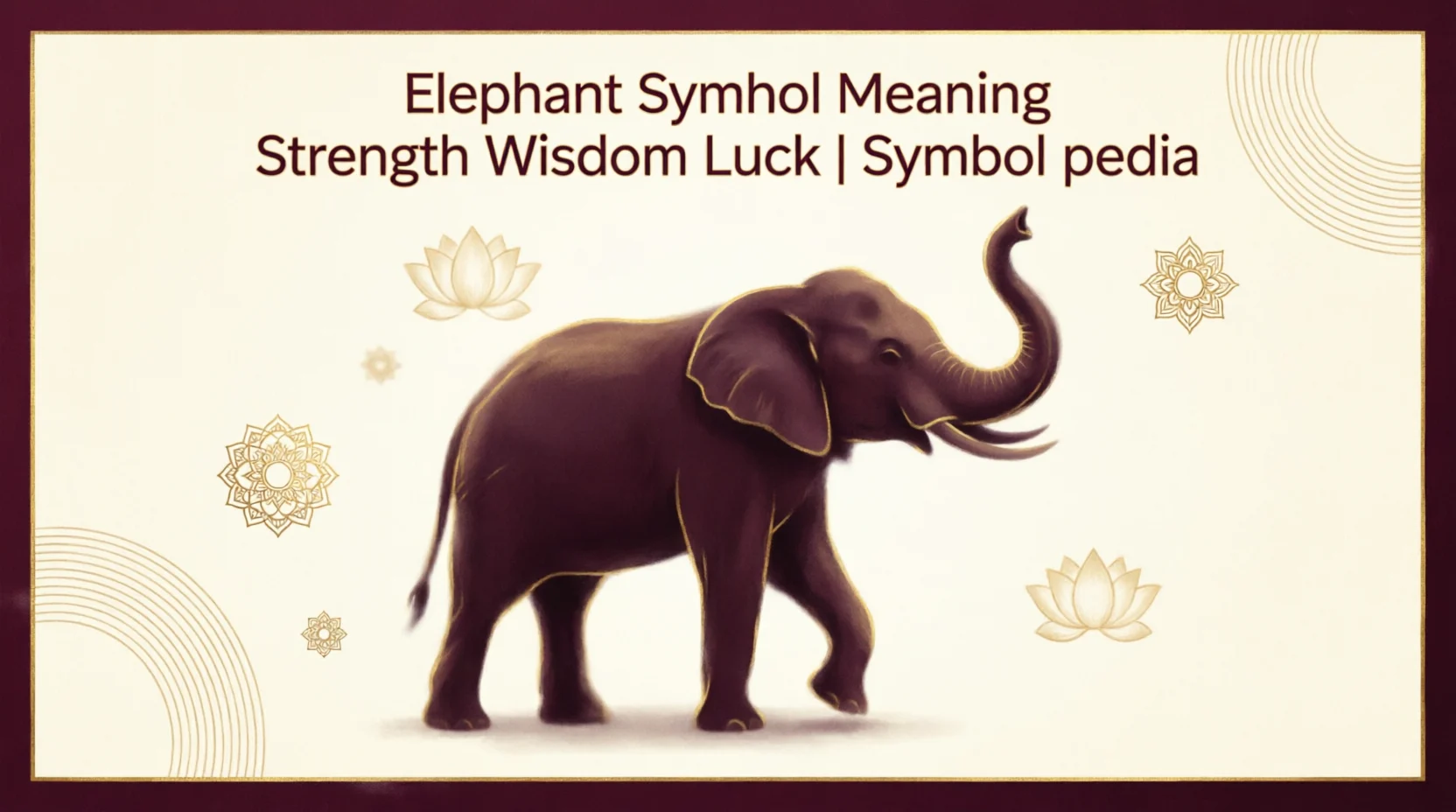
An elephant is more than a large, powerful animal. Across cultures, religions, art, jewelry, tattoos, home décor, and modern social media, the elephant has become a symbol of qualities people deeply admire: strength, wisdom, loyalty, patience, protection, memory, family, and good fortune.
That is why people often search for the elephant symbol meaning when they see an elephant tattoo, necklace, statue, logo, drawing, emoji, or decorative figure. They may wonder whether it represents strength, spiritual protection, luck, or something more personal.
The answer depends heavily on context.
An elephant facing upward may suggest optimism or good fortune to one person, while a family of elephants may represent love, unity, and protection. In South Asian religious traditions, particular elephant imagery carries much deeper spiritual associations.
So, rather than giving the elephant one fixed definition, it is more useful to understand the layers behind the symbol. Once you know the cultural and emotional background, an elephant image can feel surprisingly personal.
Elephant Symbol Meaning – Quick Meaning
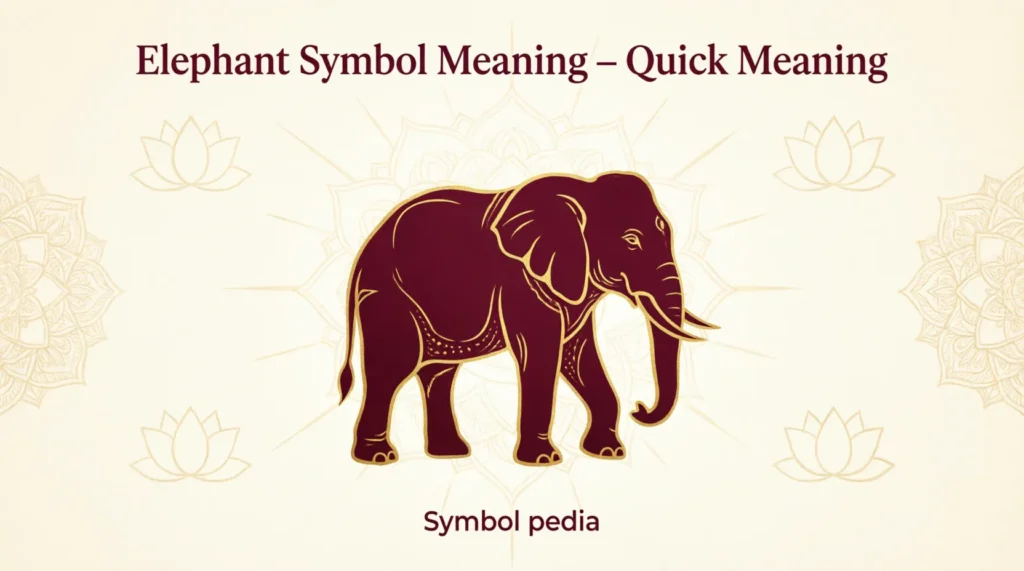
In general, the elephant symbolizes:
- Strength – physical and emotional resilience.
- Wisdom – experience, intelligence, and thoughtful decision-making.
- Loyalty – strong bonds with family and loved ones.
- Protection – safety, guardianship, and emotional security.
- Patience – moving steadily rather than rushing.
- Memory – remembrance, history, and meaningful experiences.
- Family – close relationships and community.
- Good fortune – prosperity, success, and positive energy in some traditions.
- Stability – being grounded during difficult times.
- Spiritual power – especially in particular religious and cultural contexts.
For example:
“That elephant necklace reminds me to stay strong.”
“I bought the elephant statue for good luck.”
“The elephant tattoo represents my family.”
The important point is that the symbol does not always have one universal meaning. The person using it, the design itself, and the cultural setting all matter.
Origin & Background of the Elephant Symbol
Humans have lived alongside elephants for thousands of years, particularly across parts of Africa and Asia. Their impressive size, intelligence, social behavior, and apparent emotional sensitivity naturally made them powerful symbols.
In many African cultures, elephants have been associated with qualities such as leadership, strength, ancestry, and social responsibility. The exact interpretation varies considerably between communities, so it is better to avoid treating “African elephant symbolism” as one single tradition.
In South and Southeast Asia, elephant imagery developed especially rich religious and cultural associations. The Hindu deity Ganesha, traditionally depicted with an elephant head, is associated with wisdom, learning, prosperity, and the removal of obstacles.
This is one reason elephant imagery can carry a particularly meaningful spiritual feeling for people familiar with Hindu traditions.
Elephants have also appeared in royal art, architecture, ceremonies, stories, sculpture, and decorative traditions. Their size and calm presence made them natural symbols of authority and dignity.
Over time, these older meanings moved into contemporary life.
Today, elephants appear on tattoos, bracelets, wall art, children’s products, social media graphics, business logos, inspirational posts, and gifts. Their symbolism has become more global, although traditional meanings still matter.
How Social Media Changed Elephant Symbolism
Social media has made symbolic images travel across cultures incredibly quickly.
A simple elephant illustration might now be captioned with words such as “strength,” “family,” “never forget,” or “good luck.” These associations can become popular even when the original cultural context is missing.
That does not necessarily make the modern meaning wrong. It simply means that today’s elephant symbolism often combines traditional beliefs with personal interpretation.
Real-Life Conversations About Elephant Symbolism
1. WhatsApp – A Family Symbol
Person A: I saw your new elephant picture. Why did you choose that one?
Person B: It has a baby elephant walking beside the mother.
Person A: Aww. Is it for your family?
Person B: Exactly. It reminds me that no matter how old we get, we’re still connected.
Here, the elephant represents family, protection, and emotional attachment rather than luck.
2. Instagram DM – Elephant Tattoo
Person A: Your elephant tattoo is beautiful! Does it mean something?
Person B: Yeah. I got it after a really difficult year.
Person A: So strength?
Person B: Strength and patience. Elephants don’t need to rush. I wanted a reminder that surviving slowly is still surviving.
In this situation, the elephant becomes a personal symbol of resilience and patience.
3. TikTok Comments – Elephant Meaning
Person A: Why do people keep saying elephants bring luck?
Person B: It’s connected to cultural traditions and different beliefs about elephant imagery.
Person A: So it isn’t just a random internet trend?
Person B: Nope. The symbolism goes much deeper than TikTok.
This conversation highlights an important distinction: modern social media may popularize symbolism, but many elephant associations have much older roots.
4. Text Messages – Remembering Someone
Person A: I bought an elephant charm today.
Person B: Why an elephant?
Person A: Because of Grandma. She always said elephants never forget.
Person B: That’s actually really sweet.
Here, the elephant represents memory, remembrance, and emotional continuity.
Emotional & Psychological Meaning of the Elephant Symbol
The emotional appeal of the elephant is easy to understand.
It is enormous and powerful, yet elephants are often represented as calm, social, protective, and deeply connected to their groups. That combination creates a distinctive symbolic message: you can be strong without being aggressive.
Psychologically, people may choose elephant imagery when they want to remind themselves of qualities they are developing or trying to preserve.
Someone recovering from a difficult experience might see the elephant as resilience.
Someone focused on family might see it as loyalty.
Someone starting a new chapter might interpret it as patience and steady progress.
There is also something comforting about the elephant’s association with memory. Human beings naturally attach emotional meaning to remembering people, places, and experiences.
I have seen this kind of symbolism become especially meaningful when an object is connected to a loved one. A small elephant pendant can stop being “just jewelry” and become a private reminder of someone important.
That is where symbolism becomes personal. The meaning you attach to an elephant may tell your own story as much as it reflects traditional symbolism.
Elephant Symbolism in Different Contexts
Social Media
On Instagram, TikTok, Pinterest, and other platforms, elephants frequently appear in inspirational content.
They may represent strength, self-growth, family, positivity, or emotional resilience.
Captions such as “stay strong” or “remember your worth” can give an elephant image a motivational meaning.
Friends & Relationships
An elephant can symbolize a relationship built on trust and loyalty.
A pair of elephants may represent romantic partnership, while elephants with babies can represent family bonds.
Giving someone an elephant gift can therefore communicate a message such as:
“I value our connection.”
Work & Professional Settings
In professional environments, elephant imagery may suggest stability, leadership, reliability, or wisdom.
However, context matters. An elephant logo does not automatically mean that a company wants to communicate all of these qualities.
In business, the meaning is usually shaped by the brand’s own messaging.
Casual vs. Serious Meaning
A small elephant emoji or sticker can simply be cute.
An elephant tattoo, memorial ornament, religious image, or heirloom may carry much deeper emotional significance.
Never assume that every elephant image has a spiritual meaning.
When NOT to Use the Elephant Symbol
Although elephant imagery is generally positive, context still matters.
Avoid Treating Cultural Symbols as Decorations Without Understanding Them
Some elephant imagery has genuine religious significance. If you are using an image associated with a specific tradition, take time to understand what it represents rather than treating it as a generic good-luck decoration.
Be Careful With Religious Imagery
Images connected with Ganesha, for example, have religious meaning for many Hindus. Using sacred imagery casually, disrespectfully, or purely as a fashion statement may be viewed as insensitive.
Don’t Assume Everyone Shares the Same Interpretation
An elephant tattoo may mean family to one person and spiritual strength to another.
Asking politely is usually better than making assumptions.
Professional Context
A playful elephant graphic may work perfectly well on a personal social account but may not communicate the intended message in a formal corporate document.
The design and audience should always guide your choice.
Common Misunderstandings About Elephant Symbolism
One common misunderstanding is that every elephant automatically means good luck.
Good fortune is certainly associated with elephant imagery in some cultural and popular traditions, but it is not the only meaning.
Another mistake is assuming that elephant symbolism is purely spiritual.
It can be spiritual, but it can also be emotional, cultural, decorative, personal, or psychological.
There is also confusion about elephant direction. You may see claims online that an elephant facing a particular direction always has one fixed meaning.
These interpretations are often dependent on specific traditions, practices, or modern decorative beliefs. They should not be presented as universal rules.
Most importantly, an elephant does not have one dictionary definition.
Symbols work through context.
Elephant Symbol Meaning Compared With Similar Symbols
| Symbol | Common Meaning | Main Difference |
|---|---|---|
| Elephant | Strength, wisdom, loyalty, family | Combines power with gentleness |
| Lion | Courage, authority, leadership | More strongly associated with dominance |
| Owl | Wisdom, knowledge, observation | More intellectual and mysterious |
| Turtle | Patience, longevity, protection | Emphasizes slow, steady progress |
| Bear | Strength, protection, independence | Often connected with personal power |
| Butterfly | Transformation, freedom, renewal | Focuses on change rather than stability |
| Wolf | Loyalty, instinct, community | Strong association with packs and independence |
| Dove | Peace, hope, harmony | More closely linked to peace and spirituality |
| Phoenix | Rebirth, renewal, resilience | Symbolizes rising again after destruction |
| Snake | Transformation, healing, mystery | Has both positive and negative interpretations |
Key Insight
The elephant stands out because it combines strength with gentleness, power with patience, and individuality with family connection. That balance is one reason it remains such a popular symbol across generations.
How to Respond When Someone Uses an Elephant Symbol
If someone sends you an elephant emoji, picture, sticker, or message, your response depends on the context.
Casual Replies
- “Aww, I love elephants!”
- “That’s cute 🐘”
- “Such a meaningful symbol.”
Funny Replies
- “Okay, but why is the elephant judging me? 😂”
- “Big wisdom energy!”
- “🐘 I’ll take that as a sign.”
Mature Replies
- “I like what elephants symbolize—strength without unnecessary aggression.”
- “That’s a beautiful reminder of patience and resilience.”
Respectful Replies
If you suspect the symbol has religious or cultural significance, you can ask:
- “Does the elephant have a special meaning for you?”
- “Is this connected to your culture or beliefs?”
That kind of question often leads to a much more meaningful conversation.
Regional & Cultural Usage
Western Culture
In Western popular culture, elephants are commonly associated with strength, wisdom, memory, family, and good fortune.
They frequently appear in children’s books, artwork, tattoos, jewelry, home décor, and motivational designs.
Asian Culture
Elephant symbolism can be considerably deeper across Asian cultures.
In South Asia, elephants have important religious, historical, royal, and artistic associations. Ganesha is perhaps the most recognizable example.
In various Southeast Asian traditions, elephants have also been associated with royalty, power, ceremony, and cultural heritage.
Because Asia contains many different cultures and religions, there is no single “Asian elephant meaning.”
Middle Eastern Culture
Elephant symbolism may appear through art, literature, décor, gifts, and global popular culture, but interpretations can differ depending on country, religious background, and personal experience.
It is better to ask about the person’s intended meaning than to assume one universal Middle Eastern interpretation.
Global Internet Usage
Online, elephant imagery has become almost universally recognizable as a positive symbol.
Common associations include:
strength + wisdom + family + loyalty + good luck.
However, social media often simplifies complex cultural traditions into short inspirational messages.
Gen Z vs. Millennials
Younger users may use elephant imagery as an aesthetic, emoji, tattoo concept, or motivational symbol without knowing its historical background.
Millennials and older generations may be more likely to associate it with traditional ideas such as memory, family, wisdom, or good fortune.
These are tendencies rather than strict rules. Personal experience always matters more than age alone.
Is the Elephant Symbol Safe for Kids?
Yes, elephant symbolism is generally considered kid-friendly.
Elephants are commonly used in children’s books, toys, educational materials, clothing, nursery decorations, and animal-themed content.
The only important consideration is context. If the image is part of a specific religious or cultural tradition, children can benefit from learning what the symbol represents rather than treating it as a meaningless decoration.
FAQs About Elephant Symbol Meaning
What does an elephant symbolize?
An elephant commonly symbolizes strength, wisdom, loyalty, patience, family, protection, memory, and good fortune. The exact meaning depends on cultural and personal context.
What does an elephant symbolize spiritually?
Spiritually, an elephant can represent wisdom, strength, protection, stability, and overcoming obstacles. Specific meanings vary between religious traditions.
Is an elephant a symbol of good luck?
Yes, elephant imagery is associated with good luck and prosperity in some cultural and popular traditions. However, this is only one interpretation of the symbol.
What does an elephant tattoo mean?
An elephant tattoo can symbolize strength, resilience, family, wisdom, loyalty, patience, or remembrance. The meaning usually reflects the tattoo owner’s personal story.
What does a family of elephants symbolize?
A family of elephants commonly represents love, loyalty, protection, unity, and strong bonds between generations.
What does an elephant with its trunk up mean?
An elephant with its trunk raised is popularly associated with celebration, positive energy, success, and good fortune. This interpretation is especially common in decorative symbolism.
Why are elephants associated with memory?
Elephants have long been culturally associated with strong memory, and this idea has become deeply established in popular symbolism. As a result, elephants can represent remembrance, history, and keeping important people or experiences close.
Conclusion
The elephant symbol meaning goes far beyond simply saying “strength.”
It can represent the kind of strength that stays calm under pressure, the wisdom that comes from experience, and the loyalty that keeps families and communities connected.
For some people, an elephant represents good fortune. For others, it is a reminder of a parent, child, partner, friend, or someone they have lost. A tattoo may represent surviving a difficult chapter, while a small elephant charm may simply bring a sense of comfort.
That flexibility is what makes the elephant such a powerful symbol.
If you encounter an elephant image and wonder what it means, look beyond the animal itself. Consider the design, the situation, the culture, and the person behind it.
Sometimes the most meaningful symbol is not the one with a universal definition. It is the one that quietly reminds someone of what they value most: strength, family, patience, memory, or the courage to keep moving forward.
descover more post
What Does the Nike Symbol Mean The Story Meaning Cultural …
What Does the Cadillac Symbol Mean History Hidden …
What Does the Person Symbol Mean on iPhone Meaning Settings …

Orvian is a passionate researcher and dedicated content creator focused on exploring the deeper meanings behind symbols, signs, and cultural interpretations. With a strong interest in symbolism and human psychology, Orvian simplifies complex ideas into clear, engaging, and easy-to-understand content for readers around the world.
Through consistent research and thoughtful writing, Orvian aims to provide accurate, insightful, and meaningful information that helps users connect with symbols on a deeper level—whether for personal growth, curiosity, or knowledge.
Known for a hardworking mindset and attention to detail, Orvian believes that every symbol carries a story, and every story deserves to be understood.