Have you ever spotted a chipmunk running through a garden, gathering food, or quickly disappearing into a small hole? Although this tiny animal may seem like an ordinary part of nature, its behavior carries several interesting symbolic meanings.
The chipmunk symbol meaning is commonly associated with preparation, resourcefulness, curiosity, playfulness, cleverness, and paying attention to life’s little opportunities. Because chipmunks collect and store food for later, they are often viewed as reminders to prepare for the future without forgetting to enjoy the present.
People search for chipmunk symbolism for different reasons. Some notice one repeatedly in their surroundings, while others encounter it in a dream, artwork, story, or meaningful personal moment.
The interpretation can also depend on how the animal behaves. A chipmunk collecting food may represent planning, while one playing or exploring might suggest curiosity and a need for more enjoyment.
However, it is important to understand that animal symbolism is interpretive rather than a scientifically established system. There is no single meaning that applies to everyone.
In this guide, we will explore chipmunk symbolism, its cultural background, emotional associations, spiritual interpretations, and practical lessons that make this little creature surprisingly meaningful.
Chipmunk Symbol Meaning – Quick Meaning
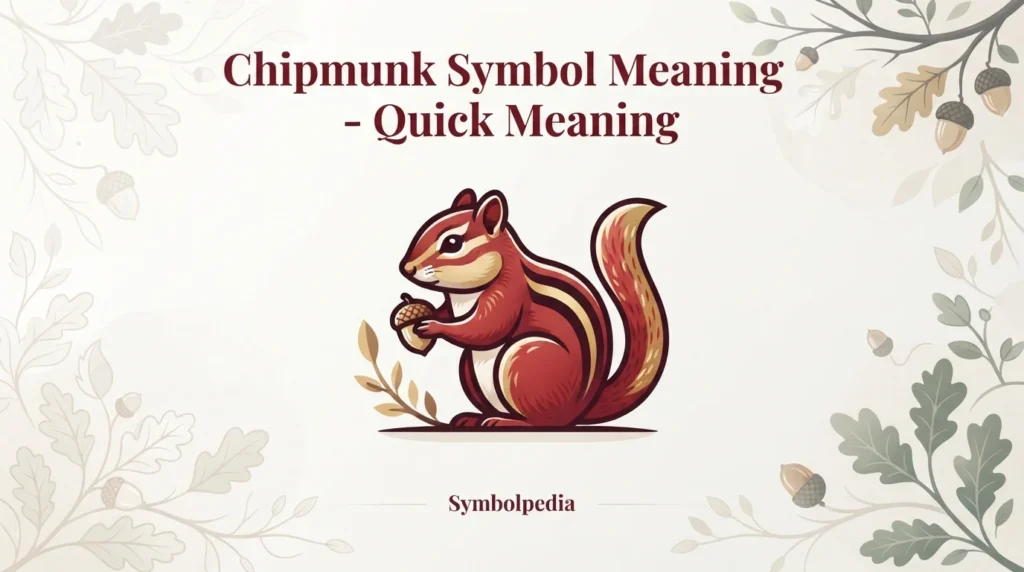
The chipmunk generally symbolizes preparation, adaptability, curiosity, intelligence, and finding happiness in simple experiences.
Its most common symbolic associations include:
- Preparation: Thinking ahead and making sensible plans.
- Resourcefulness: Making the most of what you already have.
- Curiosity: Exploring new experiences and learning.
- Playfulness: Enjoying life instead of focusing only on responsibilities.
- Alertness: Paying attention to opportunities and changes.
- Balance: Combining hard work with relaxation.
- Independence: Developing confidence in your own abilities.
- Communication: Expressing yourself with energy and enthusiasm.
Consider these symbolic examples:
“You don’t have to do everything today. Just prepare for tomorrow.”
“Sometimes the smallest opportunities bring the greatest happiness.”
“Stay curious, but remember to protect your peace.”
These expressions capture the central message associated with chipmunk symbolism: prepare wisely, stay adaptable, and appreciate the little things that make life meaningful.
Origin and Background of Chipmunk Symbolism
Chipmunks belong to the squirrel family and are particularly associated with North America. Their distinctive stripes, cheek pouches, quick movements, and food-gathering habits have made them recognizable characters in nature and storytelling.
Their symbolism developed through observations of their everyday behavior, cultural storytelling, and modern interpretations of animal characteristics.
The Meaning Behind Their Food-Gathering Habits
One of the most noticeable chipmunk behaviors is collecting food and carrying it back to a safe storage area.
This habit naturally connects the animal with preparation, responsibility, and thinking ahead.
When people observe a chipmunk gathering seeds, nuts, and other food, they may see a reflection of their own need to save money, organize responsibilities, or prepare for uncertain situations.
The symbolic lesson is simple: small efforts made consistently can create security over time.
Native American Folklore and the Chipmunk
Chipmunks appear in several North American Indigenous storytelling traditions, although stories differ between communities.
One well-known type of story explains how the chipmunk received its stripes.
In a version retold by Joseph and James Bruchac, a small squirrel challenges a boastful bear who claims he can prevent the sun from rising. When daylight arrives as expected, the squirrel laughs at the bear. The angry bear chases the smaller animal and scratches its back, creating the stripes associated with chipmunks.
This story appears in educational discussions of Indigenous folklore and illustrates how traditional narratives explain natural features while exploring themes such as pride, courage, and consequences.
It is important not to treat every Indigenous nation as having the same beliefs or interpretations. These stories belong to particular cultural traditions rather than representing one universal Native American understanding.
How Modern Symbolism Developed
Today, chipmunks frequently appear in children’s books, cartoons, nature photography, decorative artwork, and social media content.
Their small size and energetic personality make them popular symbols of innocence, enthusiasm, and cheerful determination.
Modern spiritual interpretations have expanded these associations to include abundance, positive energy, personal growth, and mindful preparation.
These contemporary meanings should be understood as modern symbolic readings, not as beliefs shared by every historical culture.
Real-Life Conversations About Chipmunk Symbolism
Animal symbolism often becomes more interesting when people discuss what an encounter means to them.
Here are four realistic examples of how chipmunk symbolism might appear in everyday conversations.
1. WhatsApp Conversation – Preparing for the Future
Person A: I saw a chipmunk collecting food in the park today.
Person B: That’s adorable! Did you take a picture?
Person A: Yes. It made me think about how I keep delaying my savings plan.
Person B: Maybe take it as a little reminder to start preparing for tomorrow.
Person A: Exactly. Small steps are better than doing nothing.
Meaning: In this conversation, the chipmunk represents preparation, financial awareness, and building a secure future through small actions.
2. Instagram DM – Enjoying Life
Person A: Your chipmunk picture is so cute!
Person B: Thank you! I love how energetic they are.
Person A: Same. I think I need some of that playful energy.
Person B: Honestly, we all need more moments of happiness without overthinking everything.
Meaning: Here, the animal represents playfulness, enthusiasm, and remembering to enjoy ordinary experiences.
3. TikTok Comments – Curiosity and Awareness
Person A: Why do chipmunks always look like they’re on a mission?
Person B: Because they’re naturally active and constantly exploring!
Person A: Their energy is something else.
Person B: Tiny animal, big determination.
Meaning: This exchange highlights curiosity, alertness, and the ability to stay motivated even when facing small challenges.
4. Text Message – Personal Growth
Person A: I keep seeing chipmunks outside my new apartment.
Person B: Maybe you just live near a place they like!
Person A: Probably. But I also like the idea of them representing a fresh start.
Person B: That’s a lovely interpretation. Make your new place feel like home, one day at a time.
Meaning: The chipmunk becomes a personal reminder of independence, adaptability, and creating a comfortable new beginning.
Emotional and Psychological Meaning of a Chipmunk
Chipmunks can represent several emotional qualities because their natural behavior resembles patterns people experience in everyday life.
Their symbolism is especially interesting when connected with motivation, personal boundaries, and emotional balance.
1. Feeling Prepared and Secure
A chipmunk’s habit of storing food can symbolize the desire for emotional and practical security.
People often feel more confident when they have a plan, savings, supportive relationships, and enough time to handle unexpected situations.
The chipmunk represents the value of creating that foundation.
2. Curiosity and Mental Energy
Chipmunks are naturally alert and inquisitive.
Symbolically, they can encourage people to ask questions, explore unfamiliar situations, and remain open to learning.
This interpretation is particularly relevant when someone feels stuck in a repetitive routine.
3. Playfulness and Happiness
The quick movements and energetic appearance of chipmunks often create an impression of excitement.
Their symbolism can remind people that adulthood does not require abandoning humor, imagination, or simple pleasures.
Sometimes, taking a short break and enjoying something small can improve your outlook.
4. Managing Anxiety and Overthinking
There is also a less positive side to chipmunk symbolism.
Constant movement and food storage can be interpreted metaphorically as nervous energy, excessive preparation, or difficulty relaxing.
A chipmunk may therefore serve as a reminder to recognize when planning becomes worrying.
A personal-style example: Imagine someone spending every evening thinking about future responsibilities. They save money, organize everything, and rarely allow themselves to relax. Seeing a chipmunk enjoying its surroundings while remaining prepared could inspire a useful reflection: being responsible is important, but happiness deserves attention too.
This is a personal interpretation, not a psychological diagnosis or established scientific message.
Chipmunk Symbolism in Different Contexts
The meaning of a chipmunk can change depending on where and how people encounter it.
Chipmunk Symbolism on Social Media
On Instagram, TikTok, Pinterest, and other platforms, chipmunks frequently appear in cute animal videos and nature photography.
They can communicate:
- Happiness and innocence.
- Busy but positive energy.
- Curiosity and exploration.
- Saving and collecting.
- A cheerful personality.
A chipmunk image can also work as a playful profile picture for someone who enjoys nature and energetic animals.
Among Friends and Relationships
In friendships, chipmunk symbolism may represent someone who brings enthusiasm and humor into a group.
It can also suggest a person who remembers small details, prepares thoughtful surprises, and values everyday moments.
In romantic relationships, the animal can represent building a future together while maintaining a playful connection.
For example, a couple might use a chipmunk illustration to symbolize saving for a shared home or enjoying their little daily adventures.
In Work and Professional Settings
In professional situations, chipmunk symbolism can represent organization, preparation, and effective use of available resources.
It may remind someone to:
- Prepare before important meetings.
- Organize tasks into manageable steps.
- Save resources for future projects.
- Remain adaptable when plans change.
- Maintain a healthy work-life balance.
However, a chipmunk is generally a playful symbol rather than a formal professional emblem.
Casual Versus Serious Meaning
In casual conversations, a chipmunk usually suggests cuteness, humor, excitement, or energetic behavior.
In more reflective conversations, it may represent patience, future planning, independence, and personal growth.
Understanding the situation helps you recognize which interpretation makes the most sense.
When NOT to Use Chipmunk Symbolism
Although chipmunks have mostly positive associations, their symbolism is not appropriate for every situation.
1. Serious Professional Discussions
Avoid using chipmunk images or metaphors when discussing sensitive workplace matters, serious financial problems, or formal responsibilities unless the comparison is genuinely relevant.
A playful reference may distract from the message.
2. Emotionally Difficult Situations
If someone is experiencing grief, financial hardship, or personal stress, telling them to embrace the chipmunk’s playful energy may sound dismissive.
Supportive communication should come before symbolic interpretations.
3. Cultural Misrepresentation
Avoid presenting a particular Indigenous story as a universal belief shared by all Indigenous communities.
Cultural traditions deserve accurate attribution and respectful treatment.
4. Assuming Every Encounter Is a Sign
Seeing a chipmunk does not automatically mean that something important will happen.
Sometimes, an animal is simply behaving naturally in its environment.
Personal meaning can be valuable without turning ordinary wildlife encounters into predictions.
Common Misunderstandings About Chipmunk Symbolism
Several misunderstandings can develop when people explore animal meanings online.
Misunderstanding 1: Chipmunks only represent wealth.
Their food-storage habits can inspire associations with abundance and preparation, but their symbolism also includes curiosity, playfulness, and adaptability.
Misunderstanding 2: Seeing a chipmunk guarantees good luck.
There is no scientific evidence that encountering a chipmunk predicts financial success, romance, or future events.
Misunderstanding 3: Chipmunk symbolism is identical across cultures.
Cultural stories and modern spiritual interpretations vary. There is no single worldwide definition.
Misunderstanding 4: Chipmunks represent laziness.
Their food-gathering behavior is actually more commonly associated with preparation and active resource management.
Misunderstanding 5: A chipmunk always represents happiness.
Its symbolism can also highlight nervousness, excessive planning, distraction, or the need for better boundaries.
Misunderstanding 6: Spiritual symbolism is scientific fact.
Symbolic interpretations are personal, cultural, or spiritual perspectives. They should not be confused with established biological or psychological findings.
Chipmunk Symbol Meaning Compared With Similar Animal Symbols
Different animals can represent similar qualities, but each has its own symbolic personality.
| Animal or Expression | Common Symbolic Meaning | Connection to Chipmunk |
|---|---|---|
| Squirrel | Preparation and resourcefulness | Both collect and store food |
| Rabbit | Fertility, gentleness, and alertness | Both can symbolize quick reactions |
| Mouse | Adaptability and attention to detail | Both demonstrate resourcefulness |
| Beaver | Hard work and building | Both connect with preparation |
| Butterfly | Transformation and freedom | Both can encourage personal growth |
| Ant | Teamwork and persistence | Both suggest consistent effort |
| Sloth | Rest and slow living | Represents the opposite of constant activity |
| Carefree living | Enjoying the present | Balances the chipmunk’s future planning |
Key Insight
The chipmunk’s distinctive message is the combination of preparation and playfulness. While some animals primarily represent strength, transformation, or patience, the chipmunk encourages people to prepare for tomorrow without sacrificing today’s happiness.
How to Respond When Someone Uses Chipmunk Symbolism
Your response should depend on the conversation and the meaning the other person wants to express.
Here are some natural replies.
Casual Replies
- “That’s actually a cute way to look at it!”
- “I love the idea of being prepared.”
- “Small animal, big life lessons!”
- “That’s such a positive interpretation.”
Funny Replies
- “So basically, I need to start saving my snacks?”
- “Time to become professionally organized!”
- “Tiny body, huge productivity goals!”
- “I guess my inner chipmunk is working overtime!”
Mature Replies
- “I think preparation and balance are both important.”
- “It’s a good reminder to think about the future.”
- “Small consistent actions can make a meaningful difference.”
- “I like the connection between patience and resourcefulness.”
Respectful Replies
- “That’s an interesting interpretation.”
- “I appreciate the cultural and personal meaning behind it.”
- “Different people may understand animal symbolism differently.”
- “I like how you connected that experience with personal growth.”
The best response is one that acknowledges the other person’s interpretation without assuming everyone shares the same beliefs.
Regional and Cultural Usage of Chipmunk Symbolism
Chipmunk symbolism is not equally established across all regions. Geography, wildlife familiarity, storytelling traditions, and modern internet culture influence how people understand this animal.
Western Culture
In the United States and Canada, chipmunks are familiar woodland animals.
They frequently appear in children’s stories, cartoons, nature photography, and outdoor experiences.
Their popular associations include playfulness, quick movement, food storage, and preparation.
Some North American Indigenous stories also feature chipmunks in traditional narratives explaining their stripes. These accounts vary between communities and should be understood within their specific cultural contexts.
Asian Culture
Chipmunks are less central to many traditional Asian symbolic systems than animals such as rabbits, dragons, tigers, and foxes.
However, modern audiences may associate chipmunks with cuteness, energetic personalities, careful preparation, and nature appreciation.
In online illustrations and animal videos, their appearance often communicates friendliness and playful energy.
These are contemporary associations rather than universal Asian cultural beliefs.
Middle Eastern Culture
Chipmunks are not generally among the major traditional symbolic animals throughout the Middle East.
Their meaning is more likely to come from modern nature content, personal interpretation, or exposure to international social media.
Someone may associate a chipmunk with saving resources, curiosity, or enjoying life’s simple moments without connecting it to an established regional tradition.
Global Internet Usage
On the global internet, chipmunks have become recognizable through cute animal videos, illustrations, memes, and nature-related content.
Their symbolism can cross language barriers because their energetic behavior is easy to understand visually.
Common online associations include happiness, curiosity, determination, and playful productivity.
Gen Z vs. Millennials
Gen Z may use chipmunk imagery in humorous memes, profile pictures, short videos, and playful online conversations.
Millennials may be more likely to connect the animal with childhood memories, nature appreciation, preparation, or personal growth.
These are broad observations rather than fixed generational rules. Individual preferences matter much more than age alone.
Is Chipmunk Symbolism Safe for Kids?
Yes. Chipmunk symbolism is generally child-friendly when explained in an age-appropriate way.
Children can learn several positive lessons from this animal:
- Save some resources for later.
- Stay curious and explore nature.
- Be prepared for everyday responsibilities.
- Enjoy playing and spending time outdoors.
- Respect small animals and their natural habitats.
Parents and teachers can also use chipmunk stories to introduce ideas about patience, decision-making, and responsible behavior.
One important distinction is that children should understand the difference between storytelling and scientific facts.
For example, a traditional story explaining how chipmunks got their stripes can be enjoyable without suggesting that the animal literally received its markings in that way.
FAQs
1. What does a chipmunk symbolize spiritually?
A chipmunk is commonly interpreted as a symbol of preparation, resourcefulness, curiosity, playfulness, and abundance. Its meaning may encourage people to plan ahead while enjoying the present.
2. Is seeing a chipmunk considered good luck?
Some people personally interpret a chipmunk encounter as a positive reminder of opportunity, preparation, or happiness. However, there is no scientific evidence that seeing one predicts good luck.
3. What does a chipmunk symbolize in dreams?
A chipmunk in a dream may be interpreted as representing preparation, nervous energy, curiosity, or attention to small details. The dream’s emotional atmosphere and your personal experiences can influence its meaning.
4. What does a chipmunk represent in love?
In relationship symbolism, a chipmunk can represent playfulness, building a secure future, sharing small moments, and maintaining enthusiasm in a partnership.
5. What does a chipmunk symbolize in Native American folklore?
Some North American Indigenous stories explain the chipmunk’s stripes through encounters with larger animals, particularly bears. Specific versions and lessons vary between cultural traditions.
6. Does a chipmunk symbolize wealth and abundance?
It can symbolize resourcefulness and preparation because chipmunks collect and store food. Some modern spiritual interpretations connect this behavior with financial planning and abundance.
7. What is the negative meaning of a chipmunk?
Its less positive symbolic associations include nervousness, excessive preparation, restlessness, distraction, and difficulty relaxing. These interpretations can serve as reminders to find a healthier balance.
Conclusion
The chipmunk may be a small animal, but its symbolism offers several meaningful lessons about everyday life.
The chipmunk symbol meaning is closely connected with preparation, curiosity, resourcefulness, playfulness, and appreciating simple experiences.
Its food-gathering habits remind us to think about the future, while its energetic personality encourages us to stay curious and enjoy the present.
Perhaps its most valuable lesson is that responsibility and happiness do not have to compete with each other. You can work toward your goals while still making room for laughter, exploration, and meaningful little moments.
The next time you see a chipmunk collecting food or quickly exploring its surroundings, consider what its behavior might remind you about your own life.
Sometimes, the smallest creatures inspire the biggest reflections.
discover more post
Bluebird Symbol Meaning Hope Happiness 2026 – Symbl Pedia
What Does BC Mean in Text Real Meaning 2026 – Symbl Pedia
What Does MM Mean in a Text Meaning Examples 2026

Kavon is a passionate content creator and digital researcher who specializes in decoding symbols, meanings, and modern internet language. With a strong focus on clarity and authenticity, Kavon writes in a way that makes complex ideas simple, relatable, and useful for everyday readers.
Known for a hardworking mindset and attention to detail, Kavon is dedicated to creating content that genuinely helps people understand the deeper meanings behind words, signs, and online expressions. Every article is crafted with care, combining research, real-life insight, and a reader-first approach.
Through Symblpedia, Kavon aims to build a trusted space where curiosity meets clarity—helping users find answers that are not only accurate but also meaningful and easy to understa